Lorvynexel
Slate Framework
Slate Framework
Couldn't load pickup availability
1. Problem Statement
A game idea can feel strong in the beginning, but it often needs a clearer frame before it can grow into a full learning project. Learners may understand one mechanic or scene, yet struggle to explain how the whole concept works together. Without a planning structure, design notes can become scattered across separate ideas, unfinished sketches, and unclear rules. This can make it harder to review progress or decide what needs more study. Slate Framework addresses that gap by giving learners a practical format for organizing game development thinking.
2. Solution
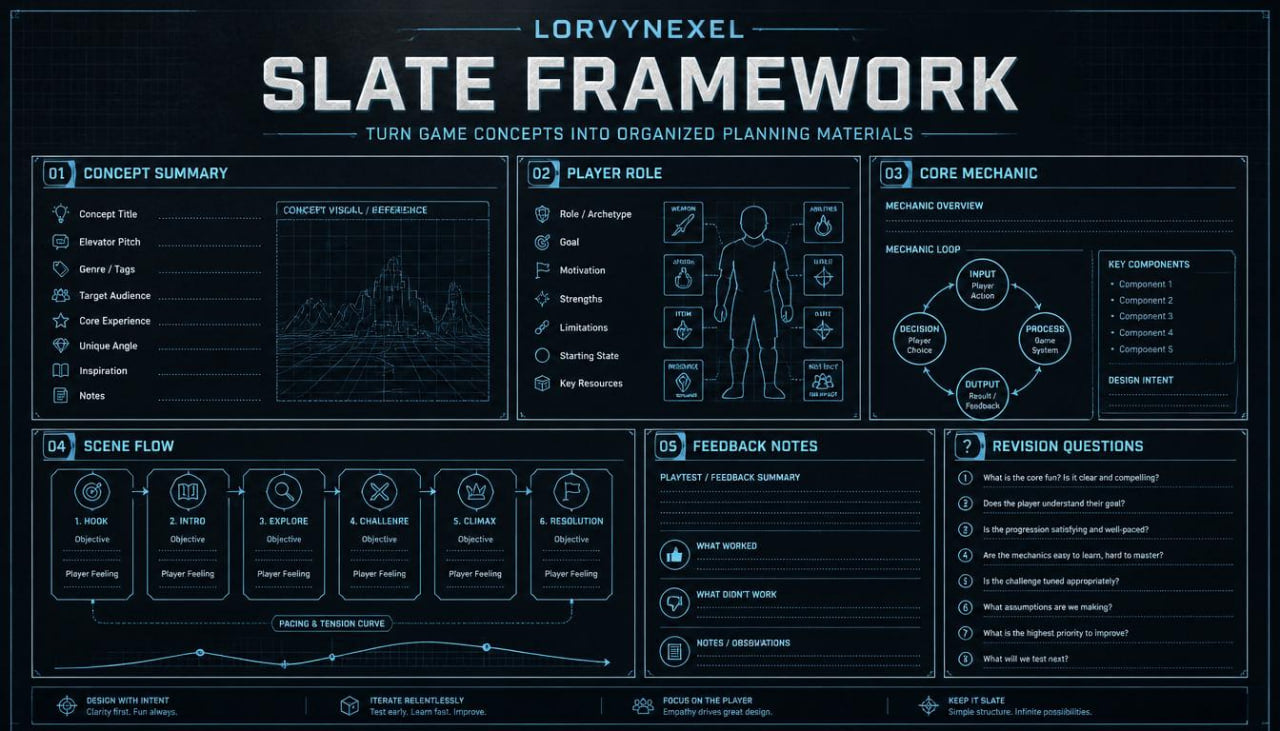
Slate Framework guides learners through the process of building a readable game concept framework. The course shows how to connect core mechanics, player goals, feedback moments, level flow, and creative notes into one organized structure. Each section gives learners a focused task that turns a loose idea into a more detailed design outline. The materials support steady practice with planning, revision, and decision-making. Learners leave this tier with a stronger habit of describing game systems in a clear and useful way.
3. What’s Inside
Slate Framework includes a set of detailed modules built around game planning structure. The first module introduces the purpose of a framework and explains how it can hold the main parts of a game idea in one place. Learners study sections such as concept summary, player role, core action, main rule set, scene type, and feedback notes.
The next module focuses on mechanics. Learners write mechanic descriptions that explain what the player does, what limits shape the action, what changes after the action, and how the game communicates that change. This section includes guided prompts for movement, object use, environmental response, resource handling, and challenge patterns.
Another module explores player flow. Learners outline how a player moves from the beginning of a scene to the next meaningful point. The materials cover entry moments, discovery points, obstacles, decision spaces, and completion states. This helps learners think about pacing without making the project too broad.
Slate Framework also includes a section on design review. Learners compare their notes against practical questions: Is the core action clear? Are the rules understandable? Does the scene have a purpose? Does the feedback match the player action? These review prompts help learners improve their own documents through careful revision.
The tier also includes framework templates, sample design outlines, writing prompts, and reflection tasks. These materials give learners a repeatable structure they can use for different game ideas.
4. Who Is This For?
Slate Framework is for learners who want to move beyond short concept notes and begin writing fuller design plans. It fits learners who enjoy structure, documentation, systems, and creative problem solving. It is also useful for people who already have several small ideas and want to organize them into one coherent learning project.
5. What You’ll Learn
- How to write a structured game concept framework
- How to connect mechanics, goals, scenes, and feedback
- How to describe player flow from start to completion
- How to organize rules and interaction notes
- How to review a design outline with practical questions
- How to revise game planning materials with clearer direction
6. 30-Day Refund Note
Slate Framework includes a 30-day refund window under the store’s posted terms. Learners can review the course materials during that period and decide whether this tier matches their current learning needs.
Self-paced learning overview
- 📁 Digital file available after purchase
- ♾️ Long-term availability
- 🔐 Secure checkout
- 🗓️ Content updated in 2026
What kind of learner are these tiers for?
What kind of learner are these tiers for?
Lorvynexel tiers are created for learners who want to explore game development through structured materials, creative tasks, and practical concepts.
Do I need prior coding knowledge?
Do I need prior coding knowledge?
No. Some tiers start with beginner-friendly ideas, while higher tiers add deeper topics and broader project thinking.
How are the materials organized?
How are the materials organized?
Each tier follows a guided learning flow with modules, notes, tasks, and resources focused on game creation.
Share