Lorvynexel
Neon Map
Neon Map
Couldn't load pickup availability
1. Problem Statement
Many game concepts become harder to understand when the space around the player is not planned with care. A scene may include interesting objects, obstacles, and goals, but the layout can still feel confusing if the player route is not described clearly. Learners may also struggle to decide where to place key moments, how to guide attention, and how to connect movement with discovery. Without a map-based design approach, world ideas can become broad sketches rather than readable play spaces. Neon Map addresses this by guiding learners through structured spatial thinking.
2. Solution
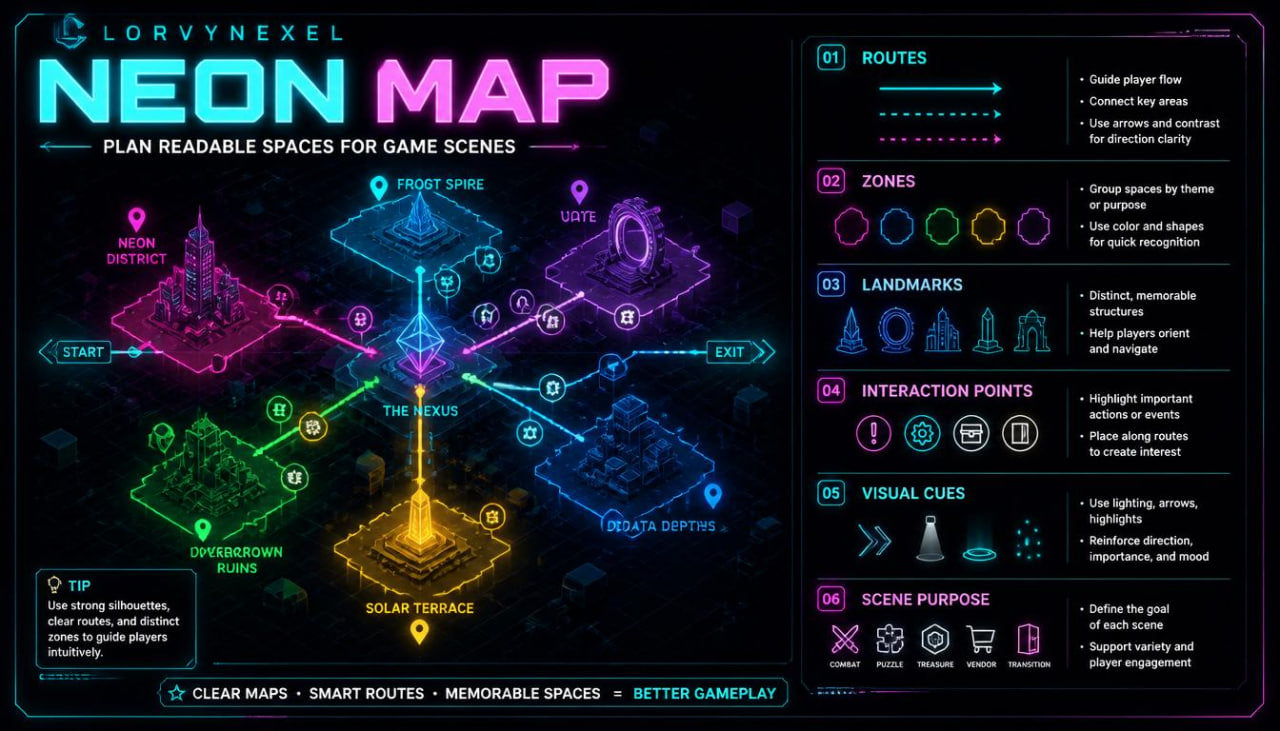
Neon Map helps learners study game space as a design system. The course explains how routes, zones, landmarks, obstacles, and interaction points can shape the way a player understands a scene. Learners practice turning loose world ideas into organized map notes and scene outlines. Each module uses practical prompts to connect layout choices with player action. The aim is to help learners build stronger habits for planning readable and purposeful game environments.
3. What’s Inside
Neon Map includes detailed modules focused on spatial design and level planning. The first module introduces map reading from a design perspective. Learners study how a space can guide movement through paths, boundaries, visible goals, and repeated landmarks.
A second module focuses on route planning. Learners outline possible player paths through a small area and describe what the player sees, does, and understands at each point. This includes entry areas, turning points, obstacles, reward moments, and exits.
Another module covers interaction placement. Learners examine where to place objects, triggers, doors, puzzles, hazards, and environmental details so they support the purpose of the scene. The materials encourage learners to explain why each element belongs in its chosen place.
Neon Map also includes a section on visual cues. Learners study how contrast, shape, spacing, object grouping, and environmental rhythm can guide attention without heavy explanation. This section uses written examples and mapping prompts rather than brand-specific references.
A later module focuses on scene zones. Learners divide a space into functional areas, such as introduction zone, challenge zone, discovery zone, rest zone, and transition zone. They then describe how each zone contributes to the full scene.
The tier includes map note templates, route worksheets, scene zone prompts, layout review questions, and practical exercises for revising spatial ideas.
4. Who Is This For?
Neon Map is for learners who enjoy world building, level design, scene planning, and environmental storytelling. It fits people who already understand basic mechanics and want to study how game spaces can guide player movement and interaction.
5. What You’ll Learn
- How to outline player routes through a game space
- How to divide scenes into useful design zones
- How to place interaction points with purpose
- How to use visual cues to guide attention
- How to connect layout with goals, obstacles, and feedback
- How to review map notes with practical design questions
6. Refund Terms
Neon Map includes a 30-day refund window under the store’s posted terms. Learners can review the materials during that period and decide whether this tier fits their current learning direction.
Self-paced learning overview
- 📁 Digital file available after purchase
- ♾️ Long-term availability
- 🔐 Secure checkout
- 🗓️ Content updated in 2026
What kind of learner are these tiers for?
What kind of learner are these tiers for?
Lorvynexel tiers are created for learners who want to explore game development through structured materials, creative tasks, and practical concepts.
Do I need prior coding knowledge?
Do I need prior coding knowledge?
No. Some tiers start with beginner-friendly ideas, while higher tiers add deeper topics and broader project thinking.
How are the materials organized?
How are the materials organized?
Each tier follows a guided learning flow with modules, notes, tasks, and resources focused on game creation.
Share