Lorvynexel
Drift Map
Drift Map
Couldn't load pickup availability
1. Problem Statement
A game space can look interesting, yet still feel unclear when movement is not planned with care. Learners may design rooms, paths, obstacles, and goals, but struggle to explain how the player should move between them. Some layouts may feel too open, while others may feel too narrow or repetitive. Movement design also affects pacing, challenge, discovery, and how the player understands the world. Drift Map addresses this by guiding learners through route planning and movement-based scene structure.
2. Solution
Drift Map gives learners a structured way to study movement as part of game development. The course materials explain how routes, turns, pauses, obstacles, and discovery points can shape a player’s experience. Learners work with mapping prompts, scene notes, and design exercises that connect movement with purpose. Each module focuses on one part of spatial flow, from first entry to final scene transition. The tier helps learners create stronger movement notes for game concepts and level ideas.
3. What’s Inside
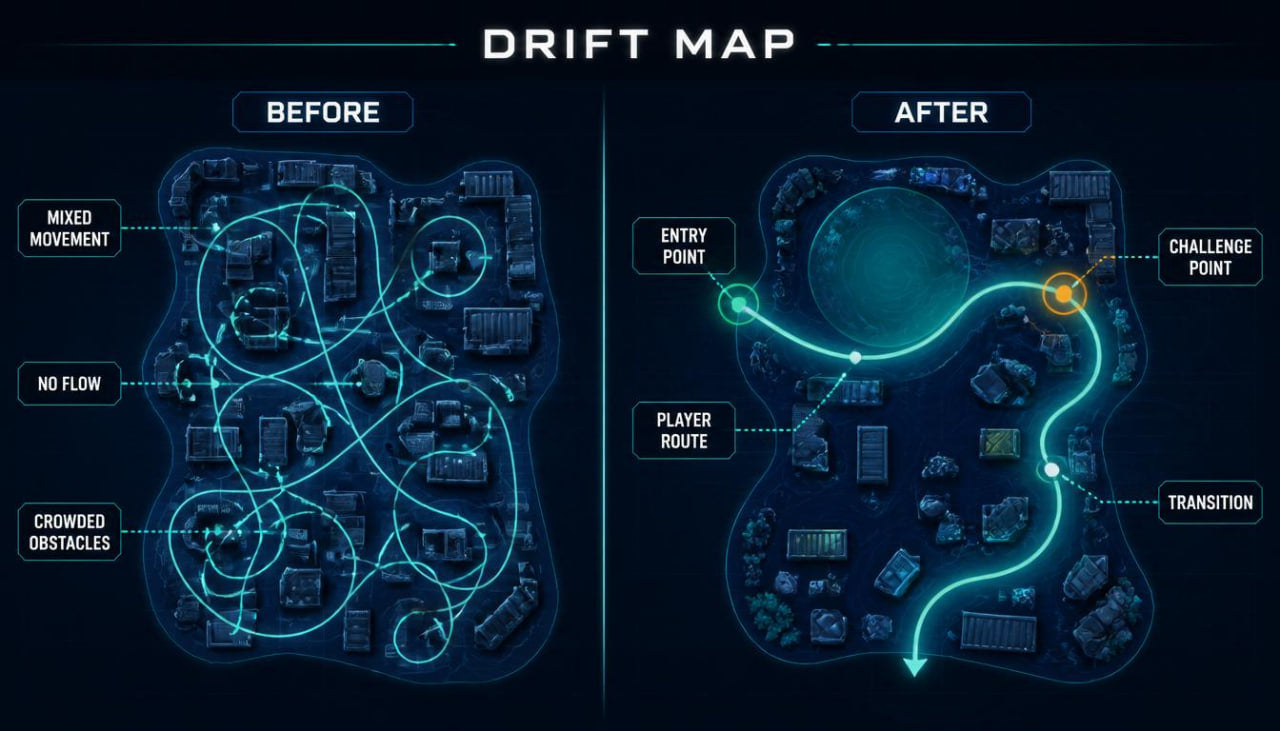
Drift Map includes modules focused on movement design, spatial rhythm, and route variation. The first module introduces movement flow. Learners study how a player enters a scene, notices a goal, chooses a path, meets an obstacle, and reaches the next area.
A second module explores route types. Learners compare direct routes, curved routes, loop routes, branching routes, and return paths. They write notes on how each route type can change the feeling of a scene and the decisions a player may make.
Another module focuses on movement pacing. Learners outline calm areas, challenge points, discovery spaces, and transition moments. This helps learners understand how movement can create rhythm without relying on heavy explanation.
Drift Map also includes obstacle placement exercises. Learners plan where barriers, gaps, locked spaces, moving hazards, and environmental puzzles may appear. Each exercise asks learners to explain how the obstacle relates to the player’s goal and what action it encourages.
A later section covers spatial revision. Learners review their map notes and ask practical questions: Is the route readable? Does each path have a purpose? Does movement connect with the mechanic? Is the player given a reason to explore? Are transitions between areas described in a useful way?
The tier includes route worksheets, movement notes, pacing prompts, scene transition templates, and revision materials. These resources help learners turn map sketches into structured design documents.
4. Who Is This For?
Drift Map is for learners interested in level design, exploration, movement systems, and spatial planning. It fits learners who already have basic game concepts and want to describe how players move through them with greater detail.
5. What You’ll Learn
- How to describe player movement through a scene
- How to compare different route types
- How to connect movement with goals and obstacles
- How to plan calm areas, challenge points, and transitions
- How to place obstacles with design purpose
- How to revise map notes through practical review questions
6. Refund Terms
Drift Map includes a 30-day refund window under the store’s posted terms. Learners can review the materials during that period and decide whether this tier fits their current learning direction.
Self-paced learning overview
- 📁 Digital file available after purchase
- ♾️ Long-term availability
- 🔐 Secure checkout
- 🗓️ Content updated in 2026
What kind of learner are these tiers for?
What kind of learner are these tiers for?
Lorvynexel tiers are created for learners who want to explore game development through structured materials, creative tasks, and practical concepts.
Do I need prior coding knowledge?
Do I need prior coding knowledge?
No. Some tiers start with beginner-friendly ideas, while higher tiers add deeper topics and broader project thinking.
How are the materials organized?
How are the materials organized?
Each tier follows a guided learning flow with modules, notes, tasks, and resources focused on game creation.
Share